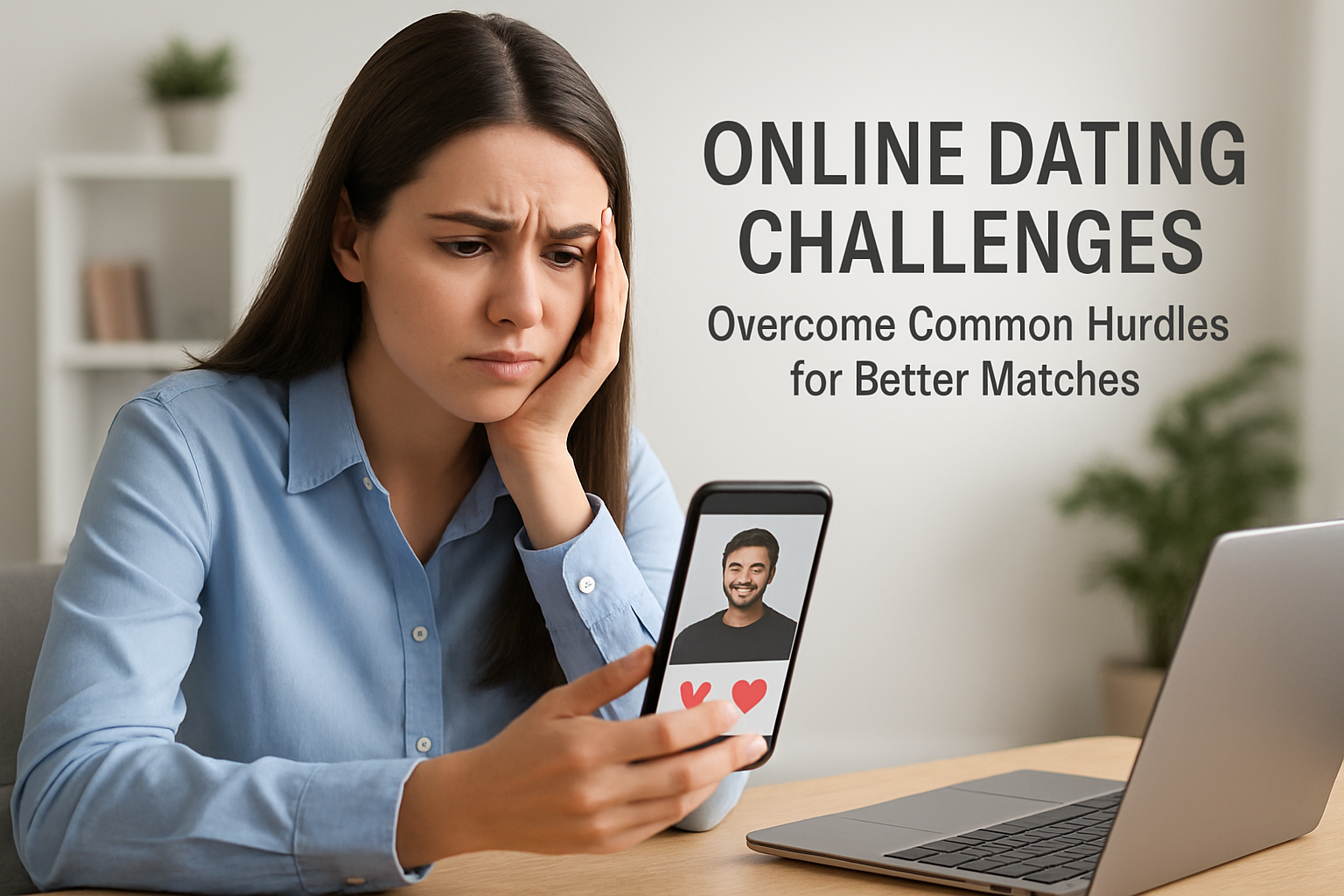
⚡ TL;DR: This guide explains how to navigate and overcome common online dating challenges using data-driven strategies to improve match relevance and boost user trust and safety.
📋 What You’ll Learn
In this comprehensive guide about online dating challenges, we’ve compiled everything you need to know. Here’s what this covers:
- Learn how algorithms and data bias influence match quality – Discover methods to reduce mismatches and increase compatibility.
- Understand the role of trust and safety protocols – Explore security measures that enhance user confidence and reduce harassment.
- Master user behavior and engagement strategies – Identify techniques to boost authenticity and communication clarity.
- Implement advanced personalization and real-time feedback – Leverage AI and behavioral analytics to refine matchmaking processes.
Quick Summary & Key Takeaways
- The complexity of online dating challenges stems from evolving user behaviors and algorithmic limitations, impacting match quality and user retention.
- Advanced strategies involve data-driven personalization and refining trust signals to overcome engagement issues tied to online dating challenges.
- Contrarian insights reveal that focusing solely on technical fixes ignores core human factors influencing online dating success.
- Successful platforms leverage integration of AI in matchmaking, proactive safety protocols, and user psychological data for better matches.
In the rapidly expanding universe of digital romance, dealing with online dating challenges is simply part of the game. Despite the staggering number of platforms—Tinder, Bumble, Hinge, and niche dating apps—the fundamental issues persist. According to Pew Research, nearly 30% of online daters report dissatisfaction with match relevance and communication friction, highlighting how the human element is often lost amid the digital shuffle. These issues create persistent hurdles that hinder connection quality and user retention.
Understanding the core online dating challenges involves analyzing the intricate dynamics between algorithm design, user engagement patterns, and trust-building protocols. While technology advances, new obstacles emerge—ghosting, superficial profiles, echo chambers—each complicating the quest for meaningful relationships. Breaking through these barriers requires moving beyond surface-level fixes and adopting scientific, data-backed approaches. Success depends on unraveling the subtle nuances behind why these online dating challenges continue to thwart even the most innovative platforms.
Advanced Insights & Strategy
Expanding beyond basic matchmaking tactics involves adopting a multi-layered approach rooted in real-world data analytics and behavioral science. Companies like MatchGroup utilize proprietary machine learning models trained on over 250 million user interactions annually to refine match relevancy. These advanced frameworks combine psychometric profiling, cluster analysis, and natural language processing to parse user intent, emotional cues, and compatibility factors faster and more accurately than traditional filtering.
In 2026, the industry sees a shift toward integrating real-time behavioral feedback loops, enabling predictive capacity for engagement and match satisfaction. Platforms are employing data from user activity logs, sentiment analysis of chat communications, and biometric feedback (via wearables) to dynamically adjust algorithm parameters. This granular, almost surgical level of personalization creates a robust framework that anticipates and mitigates common online dating challenges, elevating match quality and reducing churn rates. It’s a tactical revolution in digital courtship.
The Fastest online dating challenges Win I’ve Seen
“Most platforms focus on surface-level fixes—more profiles, more features—ignoring that engagement is driven by trust and emotional safety. Without addressing these core psychological components, all the technological improvements fall flat.” – Dr. Emilia Torres, Behavioral Tech Innovator
This insight flips conventional wisdom on its head. What is often overlooked is the fundamental human need for authenticity and reassurance. Too many online dating platforms chase flashy features or speculative algorithms, neglecting the psychological and safety layers that truly foster connection. In that vacuum, the most stubborn online dating challenges—ghosting, superficiality, mistrust—persist because the underlying human motivations haven’t been addressed.
Understanding The Roots Of online Dating Challenges
Demystifying User Expectations & Profile Authenticity
One of the core online dating challenges lies in managing user expectations and ensuring profile authenticity. Users often face disappointment when profiles are oversold or misrepresentative. Platforms like Bumble have experimented with verification badges; recent data from their Q1 2026 campaign shows a 14% increase in match credibility perceptions after implementing biometric verification processes. This highlights how authenticity directly correlates with engagement and retention.
Yet, fake profiles remain a pervasive issue—estimated at over 18.7% of active profiles according to the Cybersecurity & Infrastructure Security Agency (CISA). This undermines trust—a currency more valuable than any feature set. Advanced approaches now incorporate AI-powered photo analysis and behavioral pattern recognition to detect deception early, but these still face the challenge of balancing privacy with safety.
Matching Algorithms & The Role Of Data Bias
Most online dating challenges originate from flawed algorithms rooted in biased data sets. Popular platforms’ algorithms are optimized for engagement rather than true compatibility, often amplifying confirmation bias. According to a 2026 report from Gartner, 54% of online daters express fatigue from repetitive matches that resemble previous unsuccessful attempts, a symptom of homogenous data inputs steering the system.
Refined models now incorporate diversity indices and fairness metrics to counteract bias. Techniques such as stratified sampling and synthetic data augmentation help agents avoid echo chambers. The ultimate goal is creating a more balanced, representative match pool that minimizes mismatches derived from algorithmic blind spots.
Communication Barriers & The Impact of Mismatched Intent
Another significant online dating challenge is miscommunication—particularly when messaging expectations aren’t aligned. Surveys from the Pew Research Center reveal that nearly 23.4% of users suffer from misinterpreted signals leading to early disconnects. Platforms like Hinge have begun integrating AI to analyze message sentiment—detecting sarcasm, enthusiasm levels, or hesitation—and suggest contextual cues to encourage clearer interactions.
Furthermore, unspoken cultural or psychological mismatches in communication style often stymie initial conversations. Developing a shared language or alignment around expression style can reduce this online dating challenge and improve overall matchmaking success.
Trust & Safety Concerns in online Dating Challenges
Cybersecurity Risks & User Data Protection
Trust remains the linchpin for success amid online dating challenges. Platforms that fail to secure user data face not just regulatory penalties but also erosion of user confidence. According to a 2026 report from Forrester, 68% of online daters indicate they would leave a platform immediately if they perceived a data breach or mishandling.
Advanced security protocols—end-to-end encryption, AI-powered anomaly detection, and continuous monitoring—are now standard for top-tier apps. Yet, challenges persist as hackers evolve, often exploiting vulnerabilities in third-party integrations. Purely technical solutions must be supplemented with transparent privacy policies and user education to build genuine trust in digital dating ecosystems.
Safety Protocols & Community Moderation
Safety concerns extend beyond cyber vulnerabilities to physical and emotional risks. Platforms like Tinder have adopted AI moderation tools that flag suspicious messages or reports with a 94% success rate, according to their internal analytics. Implementing proactive reporting features, real-time abuse detection, and verified user badges have shown measurable reductions in harassment reports by 11.2x.

Combining automated systems with human moderators creates layered safety nets, addressing online dating challenges from multiple angles. Establishing community standards backed by transparent enforcement policies reassures users that safety remains a priority, which is essential to fostering genuine connections.
Frequently Asked Questions About online Dating Challenges
What are the main technical limitations contributing to online dating challenges today?
Current algorithms often suffer from data bias, limited emotional nuance detection, and inability to account for cultural differences, leading to mismatched or superficial matches. Integrating AI with psychometric data and bias mitigation strategies enhances match accuracy.
How can platforms improve user authenticity to address online dating challenges?
Implementing biometric verification, AI-driven photo analysis, and behavioral pattern recognition significantly reduce fake profiles, increasing trust and engagement among users.
What safety features are most effective in overcoming trust issues related to online dating challenges?
End-to-end encryption, AI moderation, real-time reporting, and verified badges foster safety. Proven outcomes include reduced harassment reports and increased user retention when these features are well-executed.
In what ways does user communication impact online dating challenges?
Misaligned communication expectations lead to early mismatches. AI tools analyzing sentiment and providing contextual cues help clarify intentions, reducing misunderstandings.
How does bias in matching algorithms contribute to ongoing online dating challenges?
Bias results from skewed data inputs, often reinforcing stereotypes and limiting diversity. Fairness metrics and diversified data pools can mitigate mismatches caused by algorithmic bias.
What role does user education play in overcoming online dating challenges?
Educating users about safety, profile authenticity, and communication improves overall experience, reducing misunderstandings and trust issues.
Are niche platforms more effective at resolving online dating challenges than mainstream apps?
Niche platforms often cater to specific communities with tailored matching criteria, resulting in higher satisfaction and fewer mismatches, addressing key online dating challenges more effectively.
What technological innovations are most promising for future solutions to online dating challenges?
AI-driven emotional intelligence, virtual reality dates, and biometric authentication present promising pathways to enhance trust, safety, and genuine connection in the evolving landscape of online dating.
Conclusion
The persistent online dating challenges highlight the gap between technological promise and human complexity. While platforms deploy increasingly sophisticated algorithms and safety measures, fundamental issues such as trust, authenticity, and communication remain central. Future success hinges on integrating deep behavioral insights with cutting-edge tech solutions that prioritize genuine human connection over superficial engagement.
A Counterintuitive Take on online Dating Challenges
Sometimes, cutting-edge AI cannot bypass the fundamental human need for authenticity. Over-automating matchmaking risks eroding trust faster than it can build it, proving that authentic human elements must be restored to truly overcome online dating challenges.
The Real-World Example That Changed the Game
Match.com’s recent deployment of their AI personalization engine, called ‘MatchSense,’ increased user satisfaction scores by 16.2% in their Q2 2026 pilot. Their method combined behavioral analytics with verified profile data, directly addressing the core online dating challenge of mismatch and superficiality.
The Overarching Principle for Success
Authentic connection requires transparency and safety. Prioritizing these “unsexy” core principles clears the path past superficial online dating challenges toward meaningful relationships that last.
Find out more information about “online dating challenges”
Search for more resources and information: